


Nvidia just did something it’s become insanely good at doing…it beat earnings expectations again.
Now whatever you think about how overvalued or overhyped AI stocks are, it’s getting harder to argue that this technology will simply come and go. So now the conversation has shifted from “Is AI going to be big at all?” to “Are we in an AI bubble?” and both questions are missing the nuance in-between.
Because you can believe that AI will eventually transform the entire global economy without believing that every company that adds AI to their name is going to make you rich. And you can believe that AI is a long-term opportunity to make money whilst having little to no idea which specific companies will be the winners.
I’ve been early to the AI trade, already making 6-figures from investing in AI stocks before they even became “AI stocks.” So I’d be lying if I told you that picking individual stocks is a bad way to invest in AI. But it’s not for everyone.
AI is also bigger than one company and it’s bigger than one industry. It’s become an entire ecosystem that’s layers deep.
Something I think visualises this well is Wall St. investment bank Piper Sandler’s 8-Layer AI map. And I'm using it as a way to think about the ecosystem, not as a definitive list of where you should invest. Because it’s far from perfect…tbh, I actually think it misses some obvious names.
But it does force you to look beyond obvious names and ask “What actually has to exist for AI to work?” And of course, some companies show up in more than one layer.
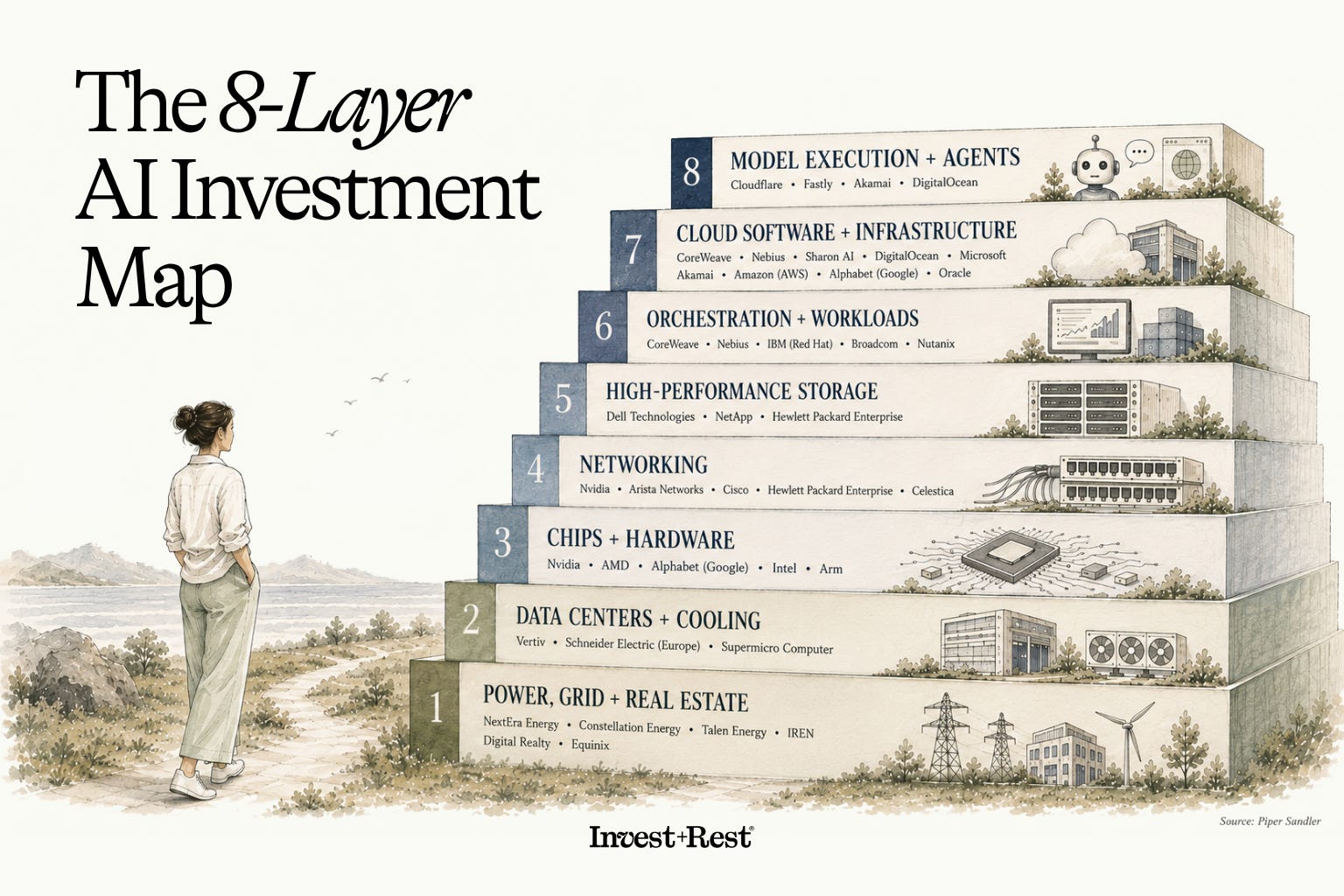
Layer 1: Power, Grid and Real Estate
AI creates demand for the physical infrastructure needed to power it.
As data centers start maxing out electrical grids, we’ll need to turn to additional support from renewables and nuclear providers. As well as capacity providers to help plug the gap and real estate giants who own the land.
NextEra Energy (NEE)
Constellation Energy (CEG)
Talen Energy (TLN)
IREN (IREN)
Digital Realty (DLR)
Equinix (EQIX)
And it’s this kind of infrastructure that has been massively underinvested in for decades, which is why it’s quickly becoming one of the biggest bottlenecks in the AI buildout.
Layer 2: Data Centers and Cooling
It’s not just about building more data centers, it’s building the specific kind with the right systems that can handle the increasingly more powerful chips and cool them the f*ck down to stop them overheating.
Power management companies are not sexy at all, but completely necessary:
Vertiv (VRT)
Schneider Electric (SU - Europe)
Supermicro Computer (SMCI)
These companies are not trying to win the AI race, they are selling what every company racing into AI actually needs.
Layer 3: Chips and Hardware
This is the layer everyone associates with AI because it’s the part people see first.
Investors associate AI demand with Nvidia’s chip demand. You can hold up a picture of an Nvidia chip and people get it immediately…this is the actual thing powering the technology.
But Nvidia can’t do this alone, so they will need a little help from its tech friends:
Nvidia (NVDA)
AMD (AMD)
Google (GOOGL)
Intel (INTC)
ARM (ARM)
But before Big Tech can sell those chips, someone has to generate the electricity, build the data center, cool it, connect the chips, store the data and provide the software infrastructure.
That’s the point of looking at AI as an ecosystem instead of a handful of companies.
Layer 4: Networking
AI chips don’t work in isolation. They need to be able to talk to one another and quickly.
Therefore AI needs high-speed computer networks connecting together thousands of chips:
Nvidia (NVDA)
Arista Networks (ANET)
Cisco (CSCO)
HP (HPE)
Celestica (CLS)
This is where you start finding companies that don’t necessarily look like AI stocks on the surface.
Layer 5: High-Performance Storage
AI is only as good as the data behind it.
And that data needs a place to live that allows it to be stored, managed, accessed and moved quickly enough.
Dell Technologies (DELL)
NetApp (NTAP)
HP (HPE)
The more AI scales, the more storage it’s going to need.
Layer 6: Orchestration and Workloads
Building AI is one thing but deciding how a business should actually use it and then getting sh*t done is another.
And that means integrating AI into already existing systems…some of which are extremely old, outdated and clunky.
Companies solving this problem include:
CoreWeave (CRWV)
Nebius (NBIS)
IBM Red Hat (IBM)
Broadcom (AVGO)
Nutanix (NTNX)
Layer 7: Cloud Software and Infrastructure
Instead of building their own data centers, most companies will save their time, money and resources and just rent what they need through the cloud from companies like:
CoreWeave (CRWV)
Nebius (NBIS)
SharonAI (SHAZ)
DigitalOcean (DOCN)
Microsoft (MSFT)
Akamai (AKAM)
AWS (AMZN)
Google (GOOGL)
Oracle (ORCL)
Because why build the whole damn thing yourself when you can just rent it from someone who already has it?
Layer 8: Model Execution and Agents
The more AI starts acting on our behalf, the more infrastructure it needs to connect with the rest of the internet like websites, apps and APIs.
Companies helping to make that possible include:
Cloudflare (NET)
Fastly (FSLY)
Akamai (AKAM)
DigitalOcean (DOCN)
AI agents are only useful if they can actually interact with the world around them.
Conviction determines your strategy
I don’t want you to just look at this AI map like a shopping list and just pick a random stock to buy, because this isn’t a game of “eenie, meenie, miney, mo.”
Instead, you need to understand the problem a company is solving to make sure it deserves a place in your portfolio.
So I want you to use this AI map as a set of questions:
What does AI need?
Where are the shortages?
What companies can fill these shortages?
But it requires a lot of conviction to take that kind of risk with a single stock. The kind of conviction that comes from understanding what you’re investing in, why you think it will win, what could go wrong and how much of your portfolio you’re willing to put behind that case.
And if you don’t have that level of conviction, there are other ways to take advantage of the opportunity. Because this isn’t black and white.
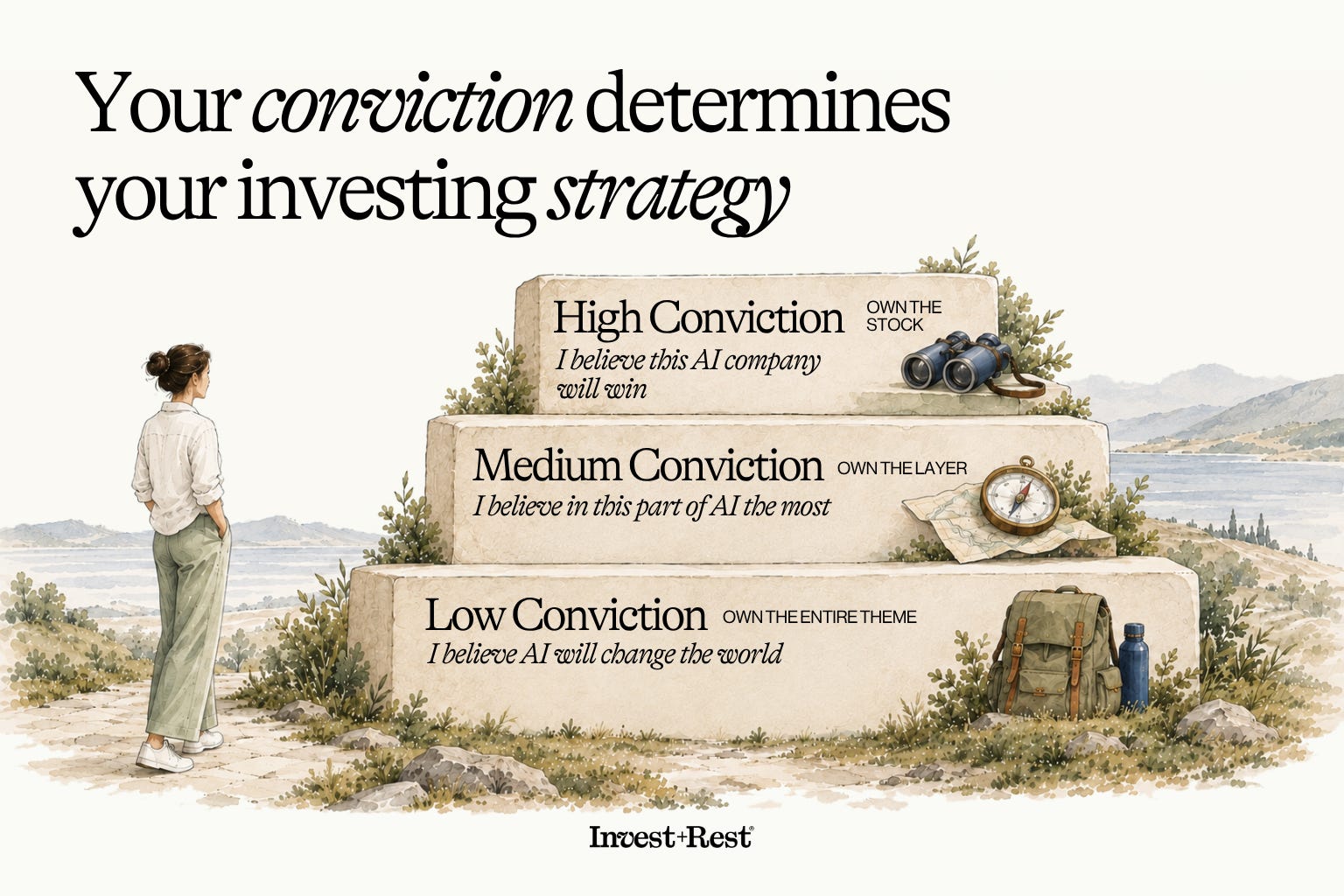
There are 3 levels of conviction:
Low Conviction: “I believe AI will change the world”
You believe AI is going to change the global economy but you:
a) don’t know what companies will win
b) don’t have the time, energy or interest to figure it out
c) don’t want your entire strategy to depend on picking the right company
d) all the above
So a sector-wide ETF allows you to buy the AI theme without taking the risk of correctly predicting the winners.
For example: Global X Artificial Intelligence & Technology ETF (AIQ/AIQU/AIQG)
Medium Conviction: “I believe in this part of AI the most”
You’ve researched one of these specific AI layers and think “That’s the one I feel strongly about.”
Maybe it’s chips, maybe it’s software, maybe it’s data centers. Now you have specific conviction but still not necessarily want that belief to depend on one company.
So a targeted ETF allows you to narrow your focus to the specific part of AI you believe in the most, whilst still spreading your risk across multiple businesses.
For example:
iShares AI Infrastructure UCITS ETF (AINF)
Roundhill Memory ETF (DRAM - US only)
High Conviction: “I believe this AI company will win”
This is where I’ve personally spent a lot of my time and where some of AI investments have already increased by 5-10x.
High conviction means understanding:
What does this company actually do?
Why does AI increase demand for it?
What gives it an advantage?
How much future growth is already priced into the stock?
What could prove me wrong?
I’m comfortable owning individual AI companies because I’ve spent the past 5 years researching and writing about them for my ghostwriting clients. That experience has given me a much stronger filter for what I understand, what I don’t and what I’m willing to take a risk on.
Don’t let someone else’s conviction become your position size
There’s more than one way to invest in a theme you believe in.
And the biggest mistake investors can make is taking on more risk than your conviction can justify.
Don’t feel like you have to own every theme
Don’t buy something just because everyone else is talking about it
Don’t assume just because you own an ETF that means there is no risk
Your job as an investor is to build a portfolio that can profit from the future without needing you to be right about everything. But it also needs to be one that you can still believe in when the economy turns to sh*t. Because there will come a time when owning AI stocks will feel f*cking terrible (more so than it does now, lol).
So you must decide how much of an AI future you want to own and how much uncertainty you’re willing to accept for owning it.
Stay Invested and Rested®,
Rebecca