

The fastest way to grow your investment portfolio (without day-trading or using leverage)
How I grew my investment portfolio from £17K to £600K+ and the strategy behind what everyone calls luck

Every time I talk about my wins of finding multiple investments that have made me 500-1,000% in returns, there’s always a response along the lines of…
“Don’t you think you were just lucky?”
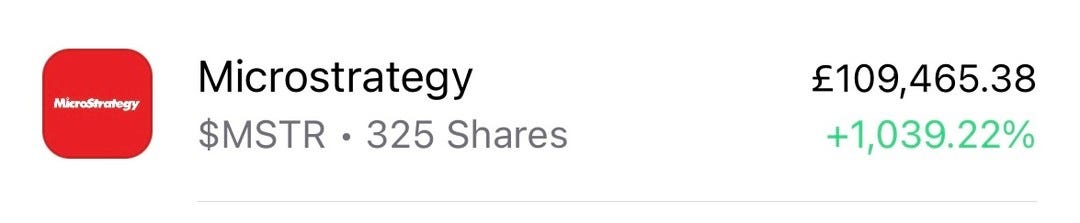


And here’s my honest answer: yes AND no.
Because the world is nuanced and luck isn’t what most people think it is.
The 4 ingredients of luck
Most people treat luck like weather: an external event outside of your control that just randomly happens to you.
But the reason people think this is because it’s easier to believe a lie than to admit the truth.
It’s easier to believe that person over there achieved that thing by a fluke, undeservingly without doing something to earn it. Because that helps you justify why you haven’t achieved that same thing. It’s easier to believe you couldn’t have done anything differently.
I can say this bluntly because I used to think like that and looking back on my life, it’s not surprising that for as long as I had that mindset, I was broke.
As soon as my mindset changed, everything else in my life did too.
Now I’ve come to realise that YOU create your own luck. Yes, you.
So yes, this is a story about a girl named Lucky.
I grew up in a family with no financial education who planned their staycations with designated stops to the betting shop along the way. I didn’t take investing seriously until I hit 30. And what I did next made me “lucky.”
Luck is 4 specific ingredients coming together at the same time, in the right order.

1. Learn (right knowledge)
Naval Ravikant describes this better than anyone: specific knowledge is knowledge society can’t give you training for. If society can train someone else (or something else) to replace you, then it’s not specific knowledge.
It’s found by pursuing genuine curiosity and it looks like play to you and work to everyone else.
Specific knowledge that can help you invest your money comes from developing pattern recognition, studying market cycles and having an awareness of where the world is going.
It’s those things that give you the ability to spot a story in its early chapters before the crowd arrives for the finale.
You need to learn to see what others miss and that doesn’t happen by accident.
2. Position (right place)
There’s an old saying in property...the 3 most important things are location, location, location. In investing, it’s positioning, positioning, positioning.
Being in the right place means having your financial foundations already in place before the opportunity arrives.
That means having:
the right investment accounts and portfolio structure
cash sitting there in your portfolio ready to buy
income every month that you can use to double down on your investments when the opportunity comes
a financial foundation stable enough that you’re making decisions from a position of strength rather than desperation
the access to the right people and platforms
The investor who wasn’t positioned correctly ahead of time couldn’t have taken advantage regardless of whether they saw an opportunity or not.
Being in the right place is an intentional choice made loooonnnnggg before the moment arrives.
3. Anticipate (right time)
You can’t control when an opportunity arrives but you can get better at recognising it when it does arrive.
Opportunities rarely arrive looking like opportunities because they don’t tend to come in a pretty little box with a cute ribbon on it.
They often come disguised as bad news, misunderstood businesses, ignored sectors, and stocks that have been falling long enough that everyone who was going to sell has already sold.
When an asset is undervalued and unpopular, your first instinct is likely to be to stay away.
That’s exactly why you need to know what you’re looking for before the moment arrives.
Investor Howard Marks calls this second-level thinking. Everyone asks “Is this a good company to invest in?” But second-level thinkers ask “Is this a good company the market has got wrong right now, and why?”
You don’t want to be researching from scratch when the opportunity arrives, you want to already know what you’re looking at.
4. Execute (right action)
Most investors will f*ck it up here in 4 ways:
not enough clarity to see the opportunity
not enough courage to buy it
not enough conviction to double down on it
not enough discipline to sell it at the right time
You have to zoom out far enough from the daily noise to notice what’s quietly sitting right in front of you.
You have to actually buy it when it still looks like a mistake.
You have to not panic sell when the price is down 50%, 60%, 70% and every instinct is telling you to cut your losses. You have to be willing to double down when the price has fallen and you feel sick looking at your portfolio.
And you have to sell when the time is right, not when it feels safe or when everyone else is buying.
Get all four right and that’s where the money is.
Luck isn’t something you wait for. You collect the ingredients needed that make you ready when it shows up.
Because not all opportunities pay the same
Some opportunities pay you a 10% return, others pay 50%.
And then there are the opportunities that change your entire life by paying you a 500% return, a 1,000% return, or even more.
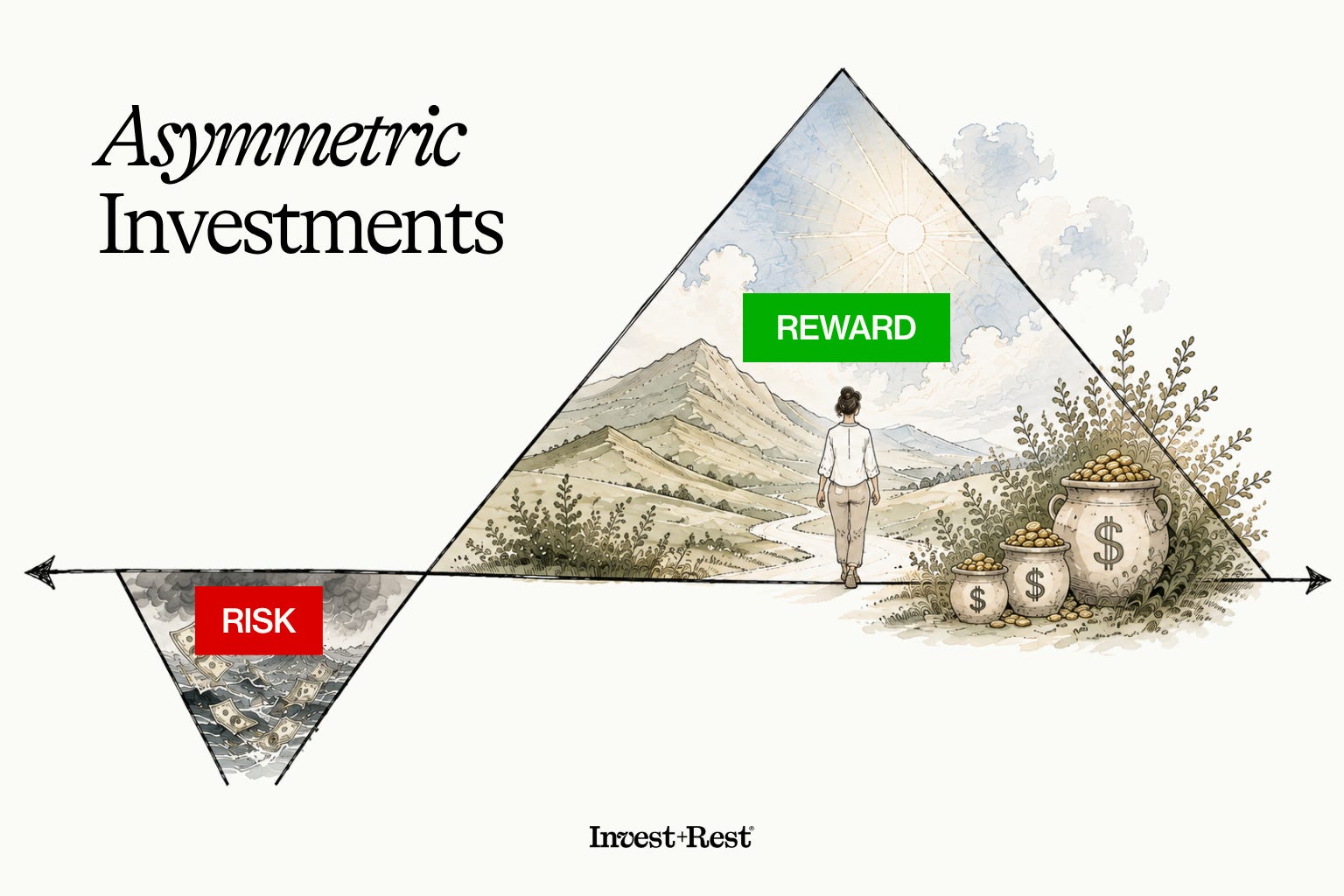
The difference is asymmetry.
An asymmetric opportunity is one where the potential return is far greater than the potential risk of losing, that the risk-to-reward ratio is in your favour. Because high reward, doesn’t always mean high risk.
You may have heard of these two golden oldies of investing: Warren Buffett and Charlie Munger (RIP Charlie). Well, their famous approach to investing was buying great companies at undervalued prices with a margin of safety built in.
The idea being is that if you buy something worth $100 for $75, it’s a no-brainer bargain buy. Even if you’re slightly wrong about what it’s really worth, there should still be enough profit in there that you’re protected against losing.
Asymmetric investing is that same idea, just after a few spicy margaritas, lol.
Because the margin of safety becomes a margin of absurdity...where the market has dramatically mispriced an opportunity so much that the gap between where it’s priced today and where it could reasonably be priced in the future isn’t 20% or 30% but 500%, 1,000% or more.
That’s the difference between growing wealth slowly and growing wealth faster without being reckless.
What makes an opportunity genuinely asymmetric
Most opportunities are not asymmetric because the majority of them are just risky with good marketing. I’ve already been there, done that and lost £10K.
But I have made multiple 6-figures from genuine asymmetric opportunities. And they have all passed these 3 tests:
Test #1: The downside is defined and survivable
This is the protection test.
Before you think about how much money you can make, you think about how much money you can lose and whether that loss is financially, mentally and emotionally survivable.
Ask yourself: “If this investment goes to zero, can I survive it?”
This tells you about your financial resilience and how much you can afford to buy before anything else.
Test #2: The upside is genuinely disproportionate
This is the asymmetry test.
Ask yourself: “Is the potential reward so far beyond the potential loss that the ratio itself is the opportunity?”
Because a good opportunity and an asymmetric opportunity are completely different things.
If it isn’t asymmetric, you will find yourself taking on far more risk for less return. And that’s just dangerous.
Test #3: The story is clear and the rules are set
This is the conviction test.
Ask yourself: “Do I actually know why this is an opportunity, and do I know what would prove me wrong?”
You can write down why this investment, at this price, in this chapter of its story, is genuinely asymmetric. And you can write down what would prove you wrong.
An investment has to pass all 3 tests, or it’s not asymmetric.
Who this is for and who it isn’t for
I have to make this very f*cking clear, because the most expensive mistake you can make with investing is using the wrong strategy for where YOU are in YOUR investing journey.
Asymmetric investing is not for beginners.
Not because beginners are less capable, I actually think you are far more capable than you believe you are, which is why I am telling you this.
But because it requires a level of self-awareness that only comes from having some investing experience first.
So if you’re still just getting started with investing, then the most powerful thing you can do right now is to start simple. A global All-World ETF, invested consistently every month, is not the boring consolation prize. It’s the foundation that makes everything else possible. Get that running first.
And if you’re already investing but not sure whether you’re ready for an asymmetric investment, I want you to imagine this:
If you woke up tomorrow and saw an investment in your portfolio was down 50% or more, what would you actually do?
If the answer is anything other than “check whether the story has changed and act accordingly” then you’re not ready yet. And that’s totally fine, that’s what the foundation is for.
Luck looks different from the inside because it’s a system working behind the scenes for years that appears invisible to the outside.
This won’t be my strategy forever. But right now, I want my money working as hard as it possibly can for me.
Now you know the system I use that gets me called “lucky.”
Stay Invested and Rested®,
Rebecca