


Lights out and away we go!
Imagine driving a Formula 1 racing car at 200 miles an hour.
Everything outside the car is moving faster than your brain can process…the track is flying past you and other cars around you are a blur.
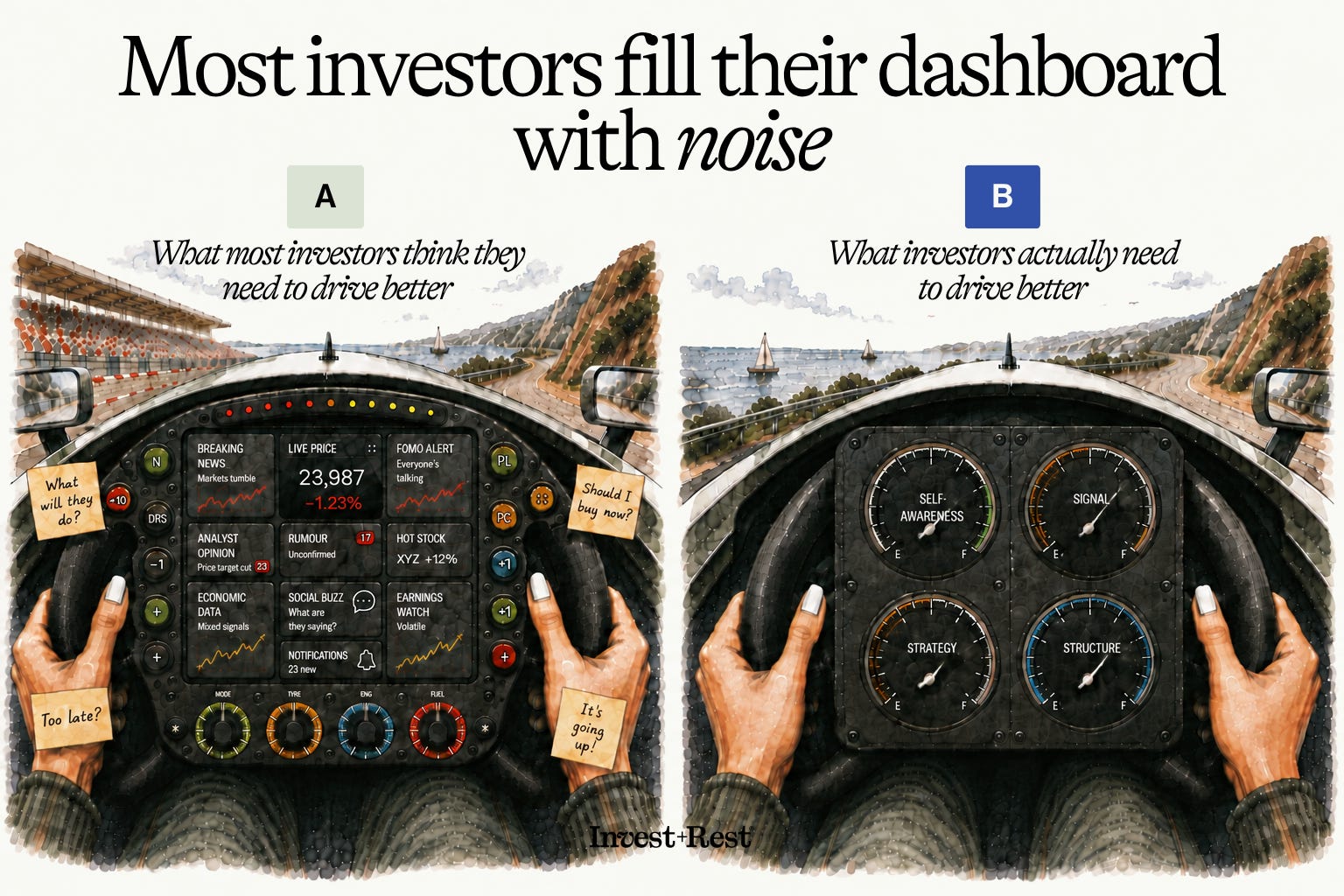
Then you glance down at the steering wheel…you see switches, lights, dials, alerts, warnings and information about almost everything happening to the car. Now imagine trying to drive successfully (and safely) while paying attention to every single signal at the same time.
You’d become overwhelmed.
And I think investing can become overwhelming extremely quickly, if you’re not careful.
Noise is everywhere, but signal is rare.
Formula 1 is one of the most data-heavy sports in the world. A modern F1 car1 has around 300 sensors generating more than 1 million telemetry data points every single second. And over a race weekend2, teams can collect over 1 terabyte of data per car, which is wild.
But having all that data is only the starting point. The best teams know which information matters, how to interpret it and when to act on it.
This is something many investors struggle with.
We have access to more information now than any generation of investors before us…market data updates by the second, economic forecasts are everywhere (and always changing) and your phone can tell you when a stock moves, when an analyst changes a price target and what thousands of strangers think about it. To make matters worse, social media has turned everyone into “experts” that it’s become harder to find genuine and trustworthy sources.
So our natural instinct is to consume more.
Because more feels like progress, but it rarely is. We assume that if we can just see more on the dashboard, we’ll be able to make better financial decisions.
But a lot of the time, it just creates more f*cking confusion.
The skill is knowing which dials on the dashboard deserve your attention, when they matter and what to do when they change.
And it comes down to these 4 things:
1. Self-awareness (the investor)
Before a Formula 1 driver steps foot into the car, they need to understand the person behind the wheel: their strengths, their weaknesses, their driving style and their goals.
Because the fastest car in the world is only useful if the driver can actually control it. Investing is the same and it’s one of the most overlooked parts of investing.
Before you assess any investment, you need to assess the investor.
Because we spend so much time asking: “What should I buy?” and far less time asking: “What kind of investor do I actually want to be?”
You can’t answer the first question, without answering the second question, first.
Because the “right” investment depends entirely on the person who owns it. The same stock can be an excellent investment for one person and completely wrong for another.
Who you are as an investor depends on your SHARP™:
Story: What am I investing for?
Horizon: When will I need the money?
Appetite: What level of risk can I take?
Role: How active do I want to be?
Pot: How much money do I have to invest?
These 5 questions create the context for every investment decision that comes after. Because investing isn’t just about finding good investments.
It’s about finding good investments for you.
2. Signal (the information)
A Formula 1 driver’s job is to focus on the information that helps them make the next decision.
Because not all information should be treated equally.
A company missing its earnings expectations might look like a reason to sell. But was it because the business is turning to sh*t? Or was it just one bad quarter?
A company’s share price falling 20% might look like a reason to sell. But did the story change? Or did only the price change?
The number itself isn’t the decision, rather the meaning behind the number is. This is where a no bullsh*t filter becomes necessary.
So before reacting to any piece of new information, ask yourself:
What does this piece of information actually change for me?
Does it change my…
reason for owning the asset?
opinion of the opportunity?
expected outcome?
decision to buy, sell or hold?
If the answer is no, then it’s just noise that you can filter out.
Noise is information that creates emotion. Signal is information that changes a decision.
The goal isn’t to react faster, it’s to minimise the noise so you can respond better.
3. Strategy (the rules)
In Formula 1, no team starts a race without a strategy.
Before the lights go out, they have already considered the variables: the car setup, the tyre choices, the fuel strategy, the expected weather conditions and run through multiple possible scenarios to plan for the good, the bad and the ugly.
Having said that, the best teams don’t blindly follow the original plan. Especially when new data suggests the original plan no longer makes sense.
Because conditions can change along the way…the rain suddenly starts pouring down and within minutes half the drivers are driving with the wrong tyres. Or a safety car comes out after a collision and the team sees an opportunity to take an early pit stop.
The teams that win know when the conditions justify changing their minds.
Investing works exactly the same.
Investors typically do not spend enough time deciding what would make them change their mind. So when the conditions do change, they are forced to make decisions in the most difficult moment possible, when uncertainty, emotion and a moving asset price are in the room with them.
The better time to decide is in advance when you are calm.
Before buying an investment, ask:
Why am I buying this?
What needs to happen for the story to play out?
What would prove me wrong?
What would make me sell?
This isn’t about predicting the future perfectly. Because no Formula 1 team can predict how every corner of a race will turn out before it starts. You just need to get the big decisions correct and be directionally right.
Like Bitcoin up 25% in a week. Is the bottom in? Is this the start of a new bull market? Or is it a summer fakeout in low volume conditions? Run it through the framework.
A 25% price move is just information. There’s no need to freak the f*ck out or FOMO in. Whether it changes your decision depends entirely on whether it changes your plan. If in doubt, dollar-cost average in and out of the market.
Because the real skill is knowing what information should change your decision and what shouldn’t.
4. Structure (the portfolio)
A Formula 1 team doesn’t just ask: “How fast can this car go?” They ask: “Where does this car need to be positioned to win the race?”
Because winning is about how all the moving parts come together: the engine, the tyres, the strategy and the conditions.
Every decision is made with the final outcome in mind.
That’s where most investor go wrong because they only think about their holdings individually: “Is this a good company?”, “Is this a good fund?” or“Is this a good opportunity?” But individual investments don’t exist in isolation. They work together as a portfolio.
The better question to consider is: Is this the right investment for my portfolio at this time to give me the best chance of achieving what I want?
Because a portfolio built for a 25-year-old accumulating wealth should look very different from one built for someone who is 55-years-old with the goal of retiring in 5 year’s time.
Neither is better. They are simply designed differently for different drivers running different races.
This is why two investors can own completely different portfolios and both be making rational decisions.
The mistake many investors make is building a portfolio by doing a little bit this, a little bit of what he said and a little bit of she did.
The goal is to invest intentionally.
The Investor Dashboard
A Formula 1 team has hundreds of people whose entire job is to analyse data, build models and make decisions. They have engineers, strategists and performance analysts all working relentlessly behind the scenes to process every possible variable.
You are one f*cking person.
And investing is probably not your full-time job.
You don’t need to monitor every market move, analyse every headline or understand every piece of data available.
You just need a simpler dashboard with only the dials that actually matter:
Self-awareness: Know yourself before choosing investments
Signal: Define what information deserves your attention
Strategy: Decide your rules before emotion takes over
Structure: Build a portfolio designed for your outcome
Because trying to watch everything is distraction.
The goal isn’t to remove uncertainty completely, because that’s not humanly possible. There will always be unexpected twists and turns along the way. The goal is to build a system that helps you navigate them.
That’s what allows you to invest calmly and confidently no matter what happens.
And ultimately, that’s what allows you to invest, and then rest.
Stay Invested and Rested®,
Rebecca